Surfing El Zonte: A Local Guide to the Wave, the Seasons, and Surf Lessons
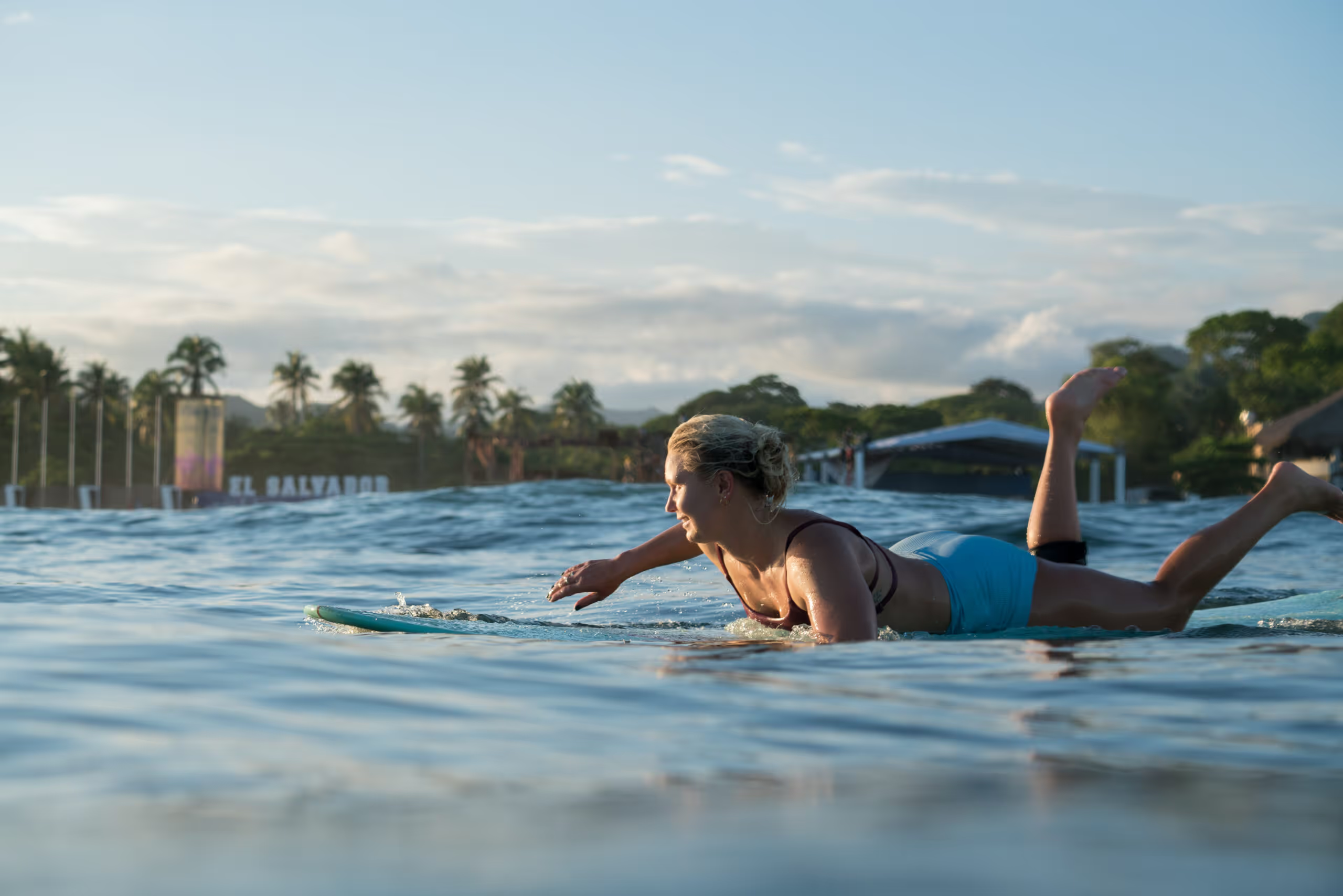
A local guide to surfing El Zonte, El Salvador: how the point breaks, the best season for your level, surf lessons and camps, prices, and what to pack.
El Zonte is one of the easiest places in El Salvador to fall in love with surfing. The village sits on a small bay on the western coast, about 50 minutes from the international airport, and its long right-hand point breaks almost every day of the year. The water stays between 80 and 85°F (27 to 29°C), so nobody here owns a wetsuit, and the wave is friendly enough for a first lesson while still giving experienced surfers long walls to work with.
We run a surf academy and a hotel in front of the El Zonte point, and our coaches are in the water here every morning. This guide puts together what we tell our own guests: how the wave works, which season suits your level, what lessons and surf camps look like, what they cost, and what to pack.
El Zonte surf at a glance
- The wave: a right-hand point break with a wide takeoff zone and a forgiving inside section. It handles all sizes and is easier to read than most points in the area.
- Who it suits: every level. Beginners and novices learn on the inside and on smaller days. Intermediate surfers get long rides on the point.
- Season: waves all year. Smaller and cleaner from November to April, bigger and more powerful from May to October.
- Best time of day: the morning, when the wind is light and offshore and the surface is clean.
- Water: 80 to 85°F (27 to 29°C). Board shorts or a swimsuit, and a rash guard for the sun.
- Getting there: about 50 minutes by car from San Salvador International Airport (SAL). Most hotels arrange the transfer.
- Nearby breaks: El Sunzal is 20 minutes east, and Punta Roca, La Bocana, and El Tunco are all within a short drive along the same coast.
How the wave works
El Salvador's Pacific coast runs roughly east to west, so swells from the south wrap into a chain of right-hand points. El Zonte is one of them. Waves stand up at the top of the point and peel to the right, toward the beach and the village. On a normal day you can watch the whole ride from the sand, which makes it a good wave to study before you paddle out.
Three zones matter:
- The peak. Where the wave first breaks at the top of the point. This is where the most experienced surfers sit, and where right of way starts.
- The shoulder and the wall. Below the peak the wave opens into a long, open face. This is where intermediate surfers practice turns and where novices catch their first unbroken waves on smaller days.
- The inside. Closer to the beach the wave softens into whitewater. It is the classroom for beginners, with room to fall and get back on the board.
That last part is the reason we run our beginner and novice programs here. The wave gives you room to fail. A forgiving inside section means more waves per session and less time getting held under, and that is what makes the first days of surfing fun instead of frustrating.
Lineup etiquette
El Zonte is mellow, but it is still a shared lineup with local surfers, students, and visitors. A few rules keep everyone safe and welcome:
- The surfer closest to the peak has priority. Look both ways before you take off.
- Never drop in on someone who is already riding the wave.
- Hold on to your board. A loose board in a crowded lineup is the most common way people get hurt.
- When you paddle back out, go wide, around the breaking waves, not through the middle of the ride.
- If you are learning, stay on the inside or go out with a coach until you can control where you go.
When to surf El Zonte: season by season
El Salvador has two seasons, and both have waves. The practical difference is size, and that should decide when you come.
Dry season: November to April
Swells are smaller and more consistent, with average wave sizes of 2 to 3 feet. Mornings are glassy, the skies are clear, and the beach weather is predictable. This is the easier window if you are learning, coming back after time off, or traveling with someone who does not surf. It is also the busiest time of year: Christmas through March is when most international surfers arrive. The hottest months are March to May, with afternoons that reach 95 to 99°F (35 to 36°C).
Rainy season: May to October
The swells get bigger and more powerful, with average wave sizes of 4 to 6 feet and head-high to occasionally double-overhead days when the south swells line up. There are smaller swells between the big ones, so it is not only for experts. Rain usually arrives in the late afternoon and evening, not all day, and the mornings tend to be clean. If you surf at an intermediate level or above, this is the season that draws surf photographers to El Salvador.
Time of day
Whatever the month, surf early. The wind is usually light and offshore in the morning, which keeps the faces smooth. Onshore breezes can pick up as the day goes on, and while they tend to stay mild, the afternoon surface is rarely as clean as the first session.
Which season fits your level
- First time surfing, or fewer than ten sessions: November to April, with lessons. The smaller waves make the learning curve gentler.
- You catch green waves and want to improve: any month. On bigger days in the rainy season your coach will take you to a spot that fits your level.
- Confident on the point and looking for power: May to October, when El Zonte and the points around it are at their best.
What level can surf El Zonte
Our academy works with The Surf Sequence, a method created by our director, Marcelo Castellanos, that splits surfing into levels the way a martial arts belt system does. Each level has its own skills, and you master them before you move on. It is a useful way to know where you stand before a trip.
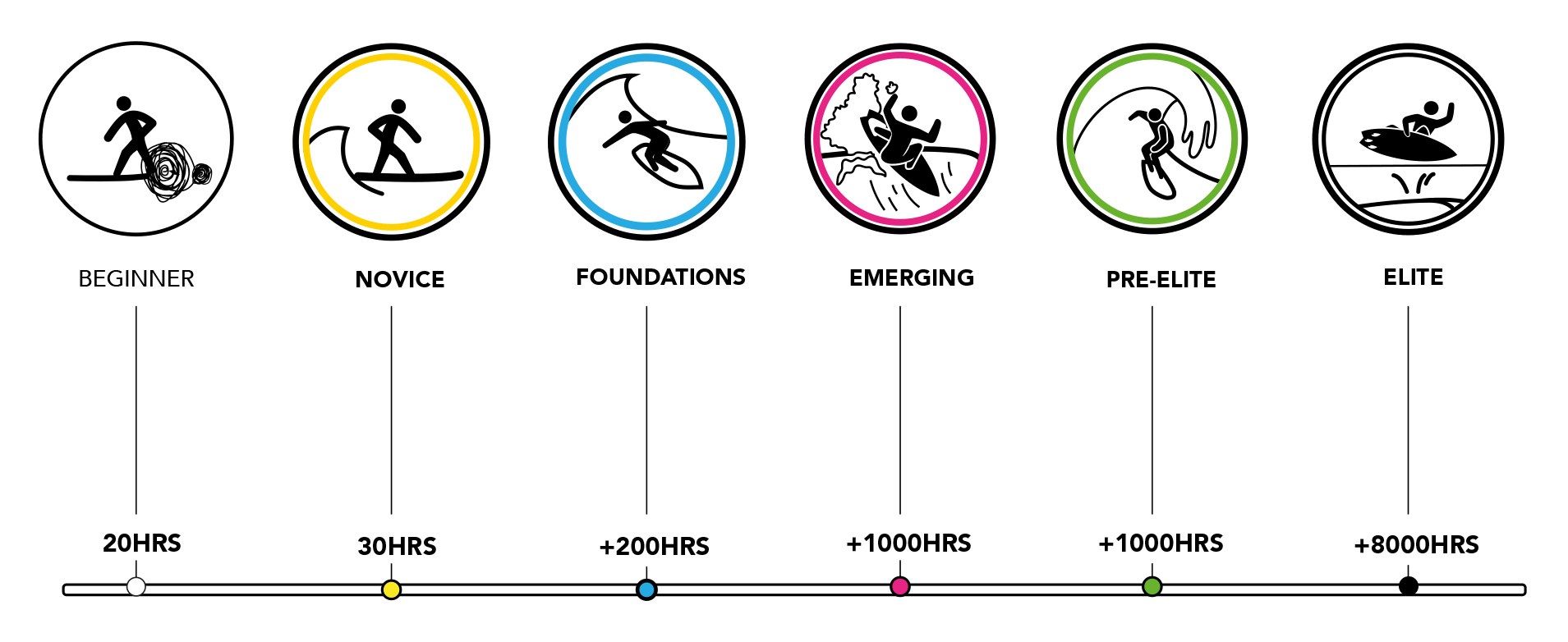
- Beginner. You have been in the ocean with a surfboard between zero and ten times. You learn the fundamentals in the whitewater: paddling, the pop-up, balance, and how to read the water. The progress map puts this stage at around 20 hours of surfing.
- Novice. You paddle out on your own and catch unbroken waves. The length of the ride is what matters now, not maneuvers. Around 30 hours.
- Foundation. You position yourself on the peak with confidence, take off with speed, and surf down the line with top-to-bottom maneuvers. This is where structured training pays off, with 200 hours and more of practice.
- Emerging, pre-elite, and elite. The competitive end of the map, from more than 1,000 hours to more than 8,000.
El Zonte works for the first three levels. Beginners stay on the inside and on smaller days, novices move onto the point as they gain control, and foundation surfers use the long walls to practice turns. If you want something heavier, Punta Roca in La Libertad is the most famous wave in the country and hosted the ISA World Surfing Games in 2021. It breaks fast and hollow over rocks, and we only send foundation-level surfers and above. El Sunzal, 20 minutes east, is another long right with an easier inside, a middle section for intermediates, and an outside peak for advanced surfers.
"Advanced surfing is basic surfing done correctly. Good foundations are the key." Marcelo Castellanos, director of Puro Surf Academy
Surf lessons in El Zonte
You can learn in El Zonte in two ways: book single classes during your stay, or commit to a surf camp with a full program. Both are coached by our team, ISA-certified and trained by Marcelo in The Surf Sequence.
What a good lesson includes
Whoever you book with, a lesson that helps you progress has four parts:
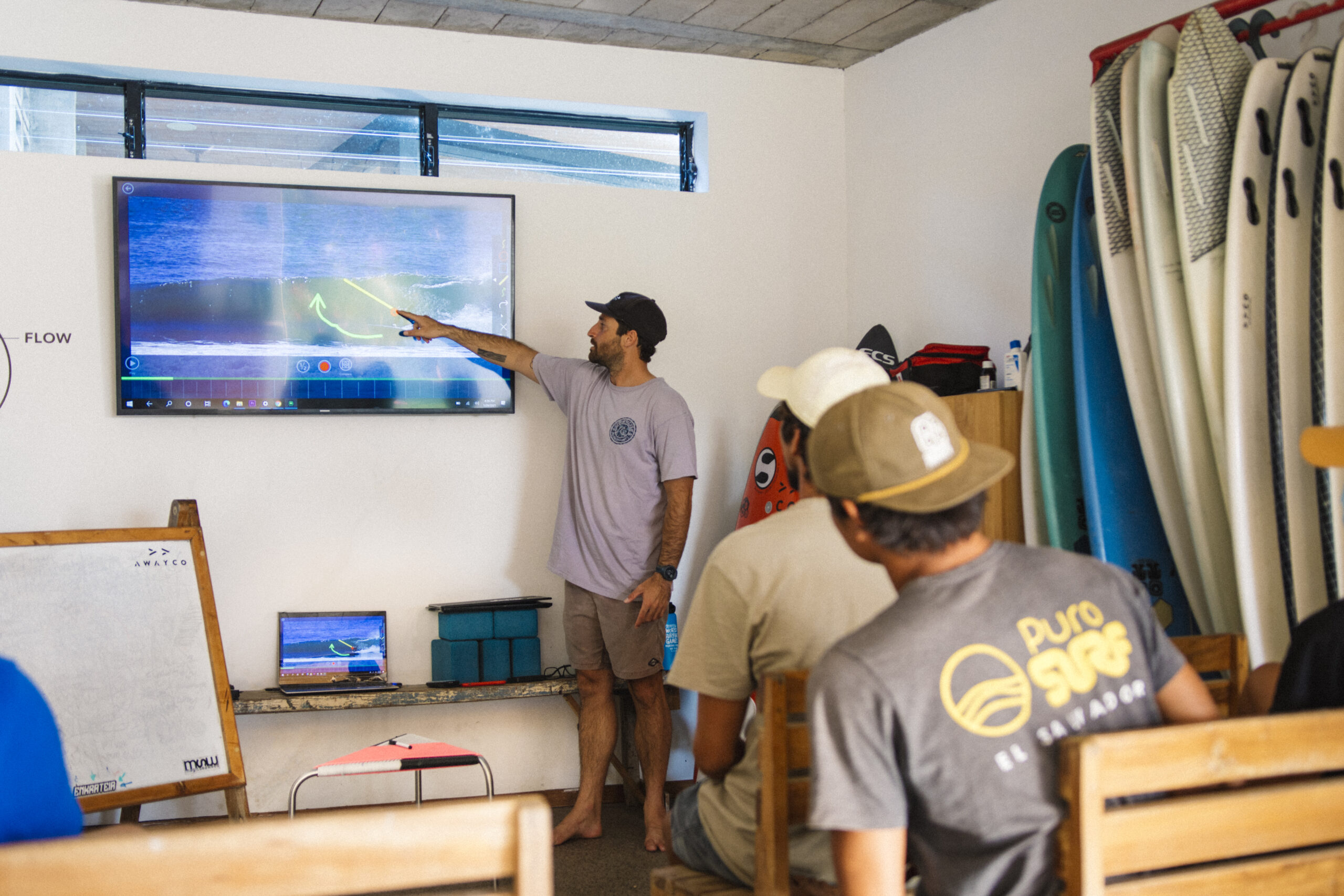
- Theory on land. A short talk about the conditions, the tide, and the goal for the session. You should know what you are working on before you get wet.
- Time in the water with your coach. Your coach picks the waves with you, helps you with positioning, and gives you feedback on the spot.
- Video. Seeing yourself surf is the fastest way to understand what to change. Feedback you only hear is easy to forget.
- Drills. Short exercises out of the water that build the muscle memory you take back into the next session.
Single classes
If you are not ready for a full program, our academy runs classes you can add to any stay:
- Surf class for all levels, from age 10.
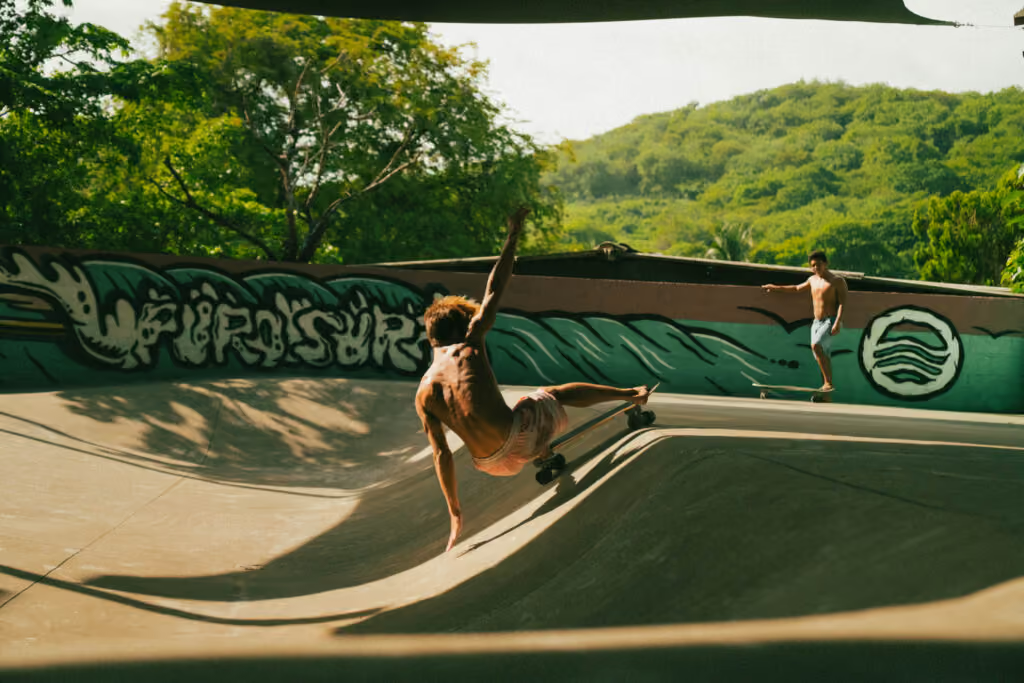
- Surf skate class on our concrete wave, to work on the body movements of surfing on land.
- Swim paddling class in the lap pool, to improve your paddling and learn the duck dive and the turtle roll.
- Yoga (from age 13), UNatural mobility, a guided ice bath with breathwork, and Brazilian Jiu-Jitsu (from age 12).
- Surf trip for intermediate and advanced surfers: a local guide takes you to the best spots of the day between Punta Roca and KM 61, with hotel pick-up and drop-off.
- Board rental for surfers who are autonomous in the water, daily from 8:00 a.m. to 5:00 p.m., with traction pads, fins, and leashes already set up.
Surf camp
The surf camp is for surfers who want a structured week of progress. Camps run every week of the year, Sunday to Sunday, in three levels (beginner, novice, and foundation), and each group has a maximum of four surfers. Every coaching day follows the same rhythm:
- 30 minutes of theory and warm-up with your coach, including visualization and focus work.
- A surf session with your coach, at the spot that best fits the day's conditions and your level, filmed from start to finish.
- 45 minutes of video analysis. The clips are emailed to you as a record of your progress.
- 45 minutes of drills in the lap pool, the gym, or on the concrete wave.
- An afternoon activity: yoga, mobility, the ice bath, a self-defense class, or a tour.
The package also includes your airport transfer, a board chosen with your coach for each coaching day, a relaxing massage, and transport to the surf spot with a driver who stays with the car. You are welcome to bring your own board.
Surf camp prices
Prices are per person in U.S. dollars, as of October 2026, and include accommodation with a daily house breakfast.
- Short week, 4 nights and 3 coaching days: $1,710 in the dorm, $1,925 in a shared double room, $2,450 in a single room.
- Full week, 7 nights and 6 coaching days: $2,580 in the dorm, $2,935 in a shared double room, $3,755 in a single room.
- Two weeks, 14 nights and 12 coaching days: $4,785 in the dorm, $5,485 in a shared double room, $7,030 in a single room.
If you already have a place to stay, the same training program runs without accommodation, Monday to Saturday or Monday to Wednesday. Write to us for that option. If you are still comparing camps, our guide on how to choose a surf camp in El Salvador lists the questions to ask any of them.
Training out of the water
Most of the progress in surfing happens between sessions. That is why the academy has a gym, a yoga room, a video analysis room, an open mat area, a 25-meter lap pool, and a concrete wave. On days when the ocean is too big or too messy for your level, the program moves to land and keeps working on technique, theory, and fitness.
A typical surf day in El Zonte
- Early morning: check the surf, breakfast, then theory and warm-up with your coach.
- Mid-morning: the surf session, while the wind is still light.
- Late morning: video analysis and drills.
- Afternoon: lunch, rest by the pool, a nap, or a class at 4:00 p.m.
- Evening: sunset from the beach, dinner, and an early night before the next morning session.
Check the conditions before you paddle out
Forecasts tell you the swell size, direction, and period, and the tide tables tell you when the point works best. Nothing beats looking at the water, though. Our El Zonte live surf cam streams the point in real time, so you can check the waves before you leave your room, or before you book your flights. Our coaches start every camp day with the same habit: read the tide, the currents, the swell, and the wind first, then decide where and when to surf.
What to pack for a surf trip to El Zonte
- Reef-safe sunscreen, ideally zinc, and a wide-brimmed hat. The sun is strong even on cloudy days.
- A rash guard or a long-sleeve surf top.
- Insect repellent for the evenings.
- A basic first-aid kit, with ear drops if you are prone to swimmer's ear.
- Light clothes and sandals. El Zonte is casual.
- Your own board if you are particular about it. Otherwise, boards are available through the academy.
- No adapter if you come from the United States or Canada: El Salvador uses the same plugs, and the U.S. dollar.

Common questions
Is El Zonte good for beginners?
Yes. The wide takeoff zone and the forgiving inside section give beginners room to practice, and the smaller waves from November to April make it even easier. Take lessons for your first sessions: waves in El Salvador are powerful even at small sizes, and good instruction in the first week saves months later.
Do I need a wetsuit in El Salvador?
No. The water stays between 80 and 85°F (27 to 29°C) all year. A rash guard is enough, mainly for sun protection.
What is the best time of year to surf El Zonte?
For beginners, November to April, with smaller and more consistent waves. For intermediate and advanced surfers, May to October, with bigger and more powerful swells and clean mornings.
Can kids take surf lessons?
Yes, from age 10. In the surf camp, groups are organized by level rather than age, so young surfers train with others at the same stage.
Can my partner come if they do not surf?
Yes. A guest who does not take part in the camp can share your room and have breakfast at no additional cost, and there is plenty to do: the pool, yoga, massages, tours, and Covana Kitchen, our beachfront restaurant.
What happens if the waves are not good?
Surfing depends on the ocean. If conditions are unsafe or unsuitable, the in-water session is replaced by technique, theory, and physical training on land, and coaches may extend later sessions when there are days left. Sessions cancelled for natural conditions are not refunded.
Where should I stay to surf El Zonte?
As close to the point as you can, so you can check the waves and walk to the water. Our guide to El Zonte hotels covers what to look for and the room options at Puro Surf.
Plan your surf trip
If you want to learn or improve in El Zonte, see the full program, levels, and dates on our surf camp in El Salvador page, or add single classes to your stay through Puro Surf Academy. To explore beyond El Zonte, our guide to surfing in El Salvador covers the other breaks on the coast. And if you are not sure which level or week fits you, write to us and we will help you plan it.